
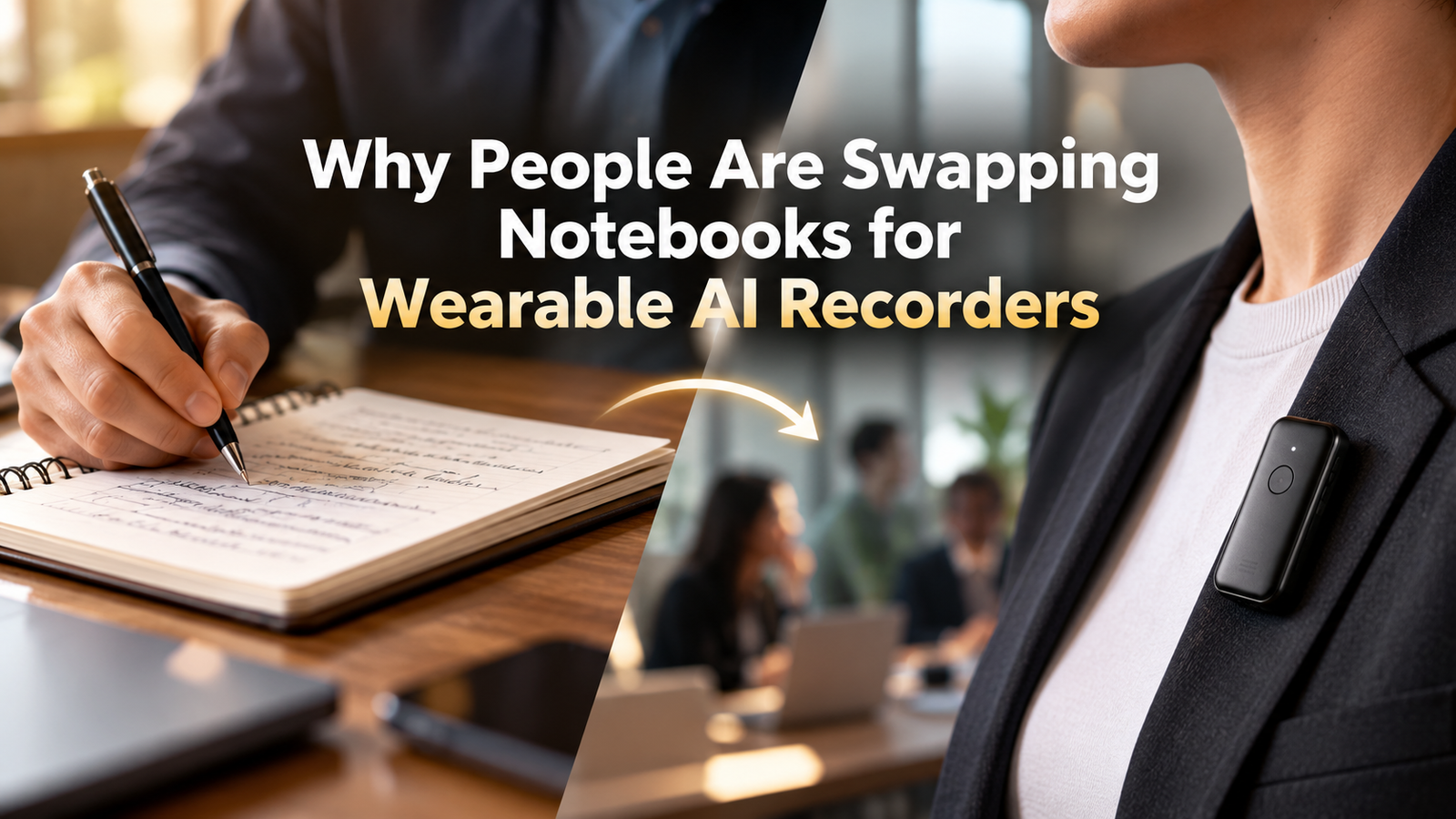
You sit down after a long meeting and try to remember what was agreed. Half of it is gone. You wrote three bullet points, but the useful part was something a colleague said in passing while you were still writing the last line. This is the quiet problem with taking notes by hand. You cannot write and listen at full attention at the same time.
Wearable AI recorders exist to fix exactly this. Instead of splitting your focus between the conversation and the page, the device captures everything, and you stay present. Later, you get a clean transcript and a short summary you can actually use.
Here is why the notebook is slowly losing its spot, and what a device like Remora does differently.
Handwriting feels productive, but it has three hidden costs.
A recorder removes all three problems at once. It captures the full conversation, keeps it word for word, and makes every line searchable.
The idea is simple. A small device stays near you and listens when you want it to. After the conversation, it turns speech into text and gives you a summary of the key points.
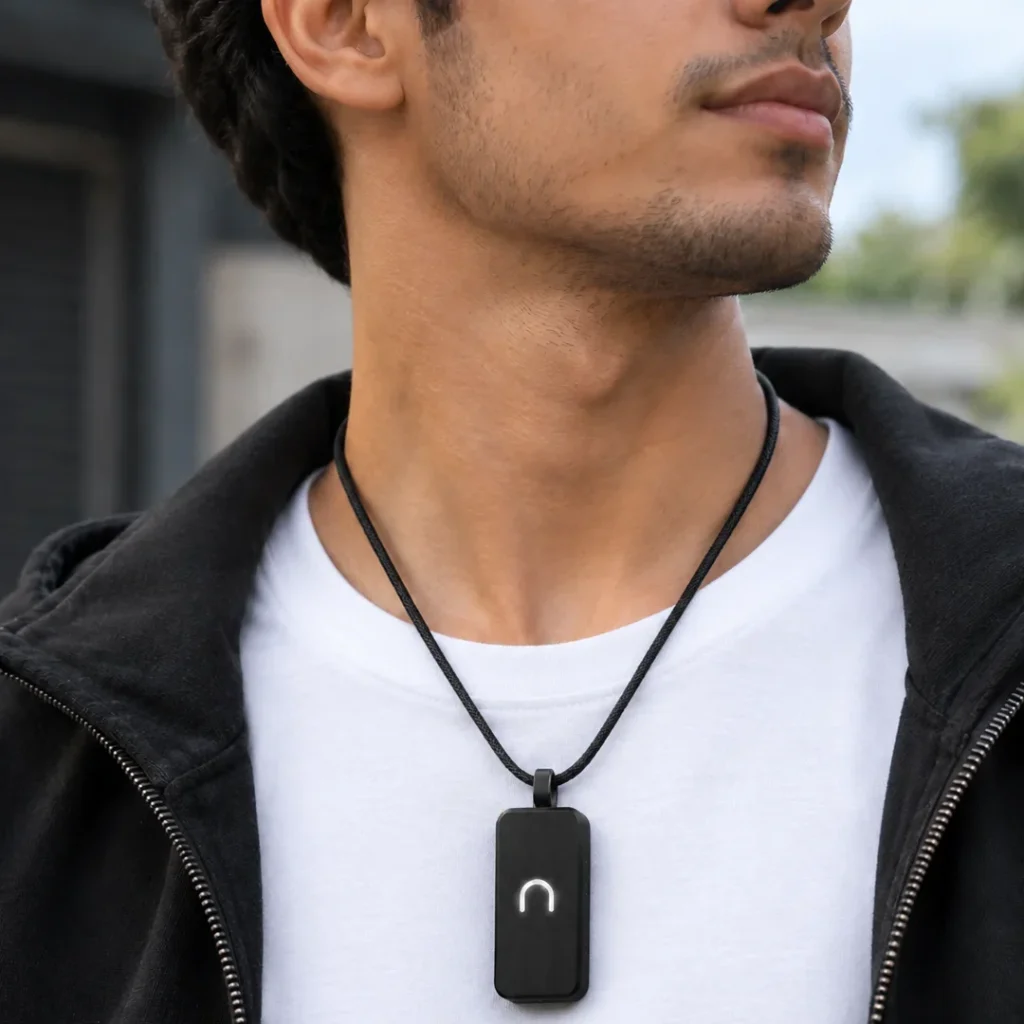
With Remora, the device goes wherever you do. Clip it to your phone, wear it as a necklace, strap it to your wrist, attach it to a backpack strap, or just set it on the desk during a meeting. The form does not change what it does. It only changes how you carry it.
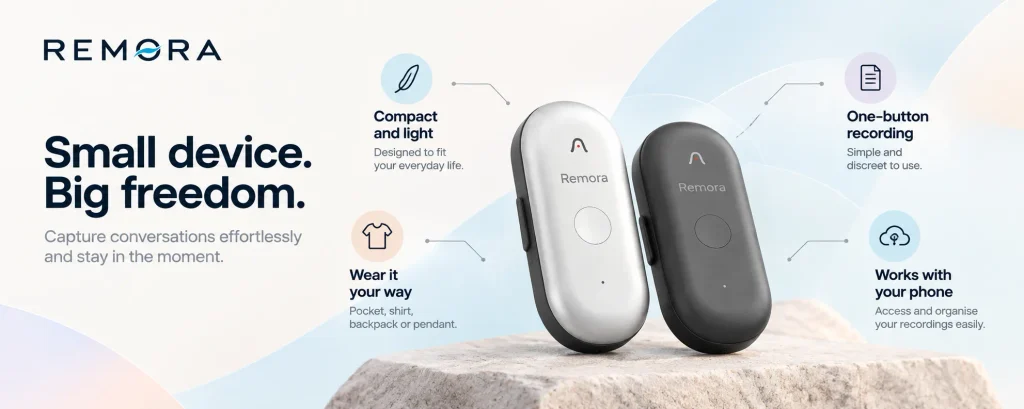
The workflow looks like this:
This is not only a tool for executives in back-to-back meetings. A few examples of people who get real use out of it:
A fair question: your phone already records audio, so why buy a device?
A phone works until the moment you actually need it. You have to unlock it, open the app, and start recording, which means the first thirty seconds are usually lost. It sits on the table screen-up, which feels intrusive in a meeting. And it is doing ten other things, so the battery and your attention are both split.
A dedicated device is always ready and does one job well. You tap once and it captures. It stays out of the way. And because recording is all it does, the capture and the transcript tend to be cleaner.
Any tool that records conversations comes with responsibility. The rules vary by country and even by state, so the safe habit is simple: tell people when you are recording. Most are fine with it once they know the goal is accurate notes, not surveillance. Treat consent as the default, not the exception.
Notebooks are not disappearing because they are bad. They are losing ground because the cost of being the only record of a conversation is too high when a better option exists. People want to be present in the room and still walk away with everything that was said. That is the whole promise of a wearable recorder, and it is why the category is growing.
If you spend your day in conversations that matter, the question is less “should I take notes” and more “should I be the one taking them.”
Does a wearable recorder work offline? Many devices capture audio offline and sync for transcription once connected. Capture and transcription are two separate steps, so recording usually does not need a live connection.
How accurate is the transcription? Accuracy depends on audio quality, background noise, and accents. Clear audio in a quiet room transcribes very well. Crowded, noisy settings are harder for any device.
Is it legal to record conversations? It depends on where you are. Some places require all parties to consent, others require only one. The simplest approach is to always let people know you are recording.
Can I search through old recordings? Yes. That is one of the biggest advantages over paper notes. Once a conversation is transcribed, a keyword search pulls up the exact moment it was said.
How is this different from my phone’s voice memo app? A voice memo gives you raw audio. A dedicated AI recorder gives you a transcript, a summary, and search, and it is ready to capture the instant you need it without unlocking a phone and opening an app.
How long does the battery last? This varies by device and how often you record. When comparing options, check both recording time on a single charge and total standby time.